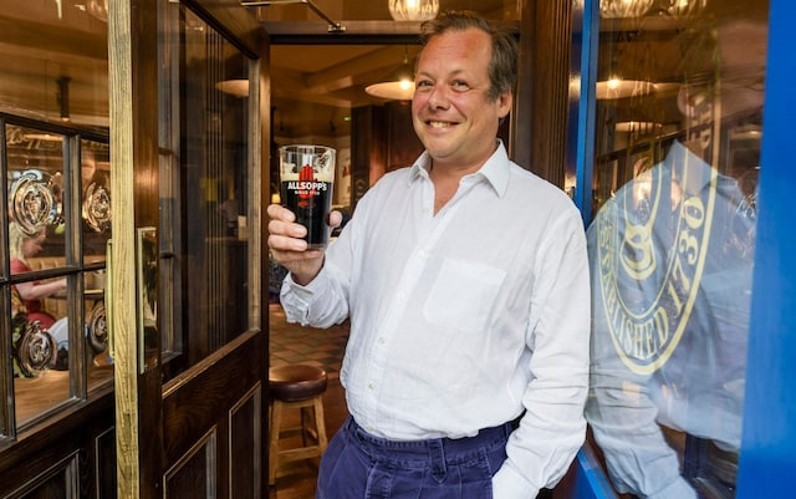
Launching Allsopp's Stout
I am beyond proud to announce the first permanent addition to our range for some time: Allsopp’s Stout.
Allsopp’s first brewed darker beers almost 300 years ago. Indeed the original success of our family business was based on the export of dark, strong beers to the court of Catherine the Great in the mid-18th Century.
Since I ‘refounded’ Allsopp’s the ambition has always been to create a distinctly English stout with its own character, its own story, and one that puts English brewing’s prominence in the history of stout back in the spotlight. People understandably associate Allsopp’s with paler beers, after all we did more or less invent India Pale Ale. But the Old Brewery also produced dark Burton ales and stout for generations before pale ale was even a thing. There’s a tendency now to speak about stout as though it belongs exclusively to the Irish brewing tradition, when in reality England had an extraordinarily rich stout culture of its own, which some argue even pre-dates that of Ireland.
This new Allsopp’s Stout has been brewed using a recipe informed by Allsopp’s last surviving brewing ledger – a leather-bound volume rediscovered during the company’s revival containing copperplate brewing records dating back centuries. Designed for enjoyers of proper stout, the beer has a malt-forward profile with notes of cocoa, roasted coffee and bitter chocolate, finishing clean and dry. We have deliberately favoured balance and restraint over more aggressive contemporary stout styles.
So, you will ask, does it taste like Guinness?
The man who brews it for us, Steve Holt of Kirkstall Brewery in Leeds, says it is to some extent an homage to how Guinness might have tasted in an earlier era albeit with a character all its own.
I would argue it is in the broadest sense of the same style but our take is deeper and more complex. Perhaps with more punch. There’s a richness and texture, but it still finishes ultra-clean. It’s designed to be the sort of pint people want to order again. And again, perhaps with a ½ dozen Achill oysters. Incidentally, we are also making a surprisingly elegant Black Velvet just now, with the Boisset Crémant.
Available now on pre-release in The Blue Stoops. It is also served by our fellow travellers at The Latimer down the road in Notting Hill.
Stout Quote
The Irish may or may not have invented stout, but they definitely write about it beautifully. Here Leopold Bloom pops into the Burton Restaurant for a quick one in Ulysses. The spelling is Joyce's own.
He gazed round the stooled and tabled eaters, tightening the wings of his nose.
—Two stouts here.
—One corned and cabbage.
That fellow ramming a knifeful of cabbage down as if his life depended on it. Good stroke. Give me the fidgets to look. Safer to eat from his three hands. Tear it limb from limb. Second nature to him. Born with a silver knife in his mouth. That’s witty, I think. Or no. Silver means born rich. Born with a knife. But then the allusion is lost.
An illgirt server gathered sticky clattering plates. Rock, the head bailiff, standing at the bar blew the foamy crown from his tankard. Well up: it splashed yellow near his boot. A diner, knife and fork upright, elbows on table, ready for a second helping stared towards the foodlift across his stained square of newspaper. Other chap telling him something with his mouth full. Sympathetic listener. Table talk. I munched hum un thu Unchster Bunk un Munchday. Ha? Did you, faith?
Mr Bloom raised two fingers doubtfully to his lips. His eyes said:
—Not here. Don’t see him.
Out. I hate dirty eaters.
He backed towards the door. Get a light snack in Davy Byrne’s. Stopgap. Keep me going. Had a good breakfast.
—Roast and mashed here.
—Pint of stout.
Every fellow for his own, tooth and nail. Gulp. Grub. Gulp. Gobstuff.
He came out into clearer air and turned back towards Grafton street. Eat or be eaten. Kill! Kill!
From Ulysses by James Joyce, 1922.